Mostrar mensagens com a etiqueta Christina Rossetti. Mostrar todas as mensagens

sexta-feira, 25 de janeiro de 2013

«I Am Christina Rossetti»


Hoje comemorar-se-ia o aniversário da escritora britânica Virginia Woolf, autora conhecida por romances como 'Mrs. Dalloway', 'Orlando' ou 'Os Anos'. Ainda que tenha sido reconhecida essencialmente como romancista, a vários títulos revolucionária, Woolf foi também autora de vários contos, ensaios e reflexões.
Um pouco para celebrar esta sua data, pensei em transcrever um texto do livro 'The Common Reader', escrito em 1930, quando precisamente se celebravam os 100 anos sobre o nascimento da minha poeta preferida, Christina Rossetti [1830-1896], sobre quem Virginia fala com uma actualidade impressionante para a época, e a quem se dirige directamente.


On the fifth of this December Christina Rossetti will celebrate her centenary, or, more properly speaking, we shall celebrate it for her, and perhaps not a little to her distress, for she was one of the shyest of women, and to be spoken of, as we shall certainly speak of her, would have caused her acute discomfort. Nevertheless, it is inevitable; centenaries are inexorable; talk of her we must. We shall read her life; we shall read her letters; we shall study her portraits, speculate about her diseases — of which she had a great variety; and rattle the drawers of her writing-table, which are for the most part empty. Let us begin with the biography — for what could be more amusing? As everybody knows, the fascination of reading biographies is irresistible. No sooner have we opened the pages of Miss Sandars’s careful and competent book (Life of Christina Rossetti, by Mary F. Sandars. (Hutchinson)) than the old illusion comes over us. Here is the past and all its inhabitants miraculously sealed as in a magic tank; all we have to do is to look and to listen and to listen and to look and soon the little figures — for they are rather under life size — will begin to move and to speak, and as they move we shall arrange them in all sorts of patterns of which they were ignorant, for they thought when they were alive that they could go where they liked; and as they speak we shall read into their sayings all kinds of meanings which never struck them, for they believed when they were alive that they said straight off whatever came into their heads. But once you are in a biography all is different.
Here, then, is Hallam Street, Portland Place, about the year 1830; and here are the Rossettis, an Italian family consisting of father and mother and four small children. The street was unfashionable and the home rather poverty-stricken; but the poverty did not matter, for, being foreigners, the Rossettis did not care much about the customs and conventions of the usual middle-class British family. They kept themselves to themselves, dressed as they liked, entertained Italian exiles, among them organ-grinders and other distressed compatriots, and made ends meet by teaching and writing and other odd jobs. By degrees Christina detached herself from the family group. It is plain that she was a quiet and observant child, with her own way of life already fixed in her head — she was to write — but all the more did she admire the superior competence of her elders. Soon we begin to surround her with a few friends and to endow her with a few characteristics. She detested parties. She dressed anyhow. She liked her brother’s friends and little gatherings of young artists and poets who were to reform the world, rather to her amusement, for although so sedate, she was also whimsical and freakish, and liked making fun of people who took themselves with egotistic solemnity. And though she meant to be a poet she had very little of the vanity and stress of young poets; her verses seem to have formed themselves whole and entire in her head, and she did not worry very much what was said of them because in her own mind she knew that they were good. She had also immense powers of admiration — for her mother, for example, who was so quiet, and so sagacious, so simple and so sincere; and for her elder sister Maria, who had no taste for painting or for poetry, but was, for that very reason, perhaps more vigorous and effective in daily life. For example, Maria always refused to visit the Mummy Room at the British Museum because, she said, the Day of Resurrection might suddenly dawn and it would be very unseemly if the corpses had to put on immortality under the gaze of mere sight-seers — a reflection which had not struck Christina, but seemed to her admirable. Here, of course, we, who are outside the tank, enjoy a hearty laugh, but Christina, who is inside the tank and exposed to all its heats and currents, thought her sister’s conduct worthy of the highest respect. Indeed, if we look at her a little more closely we shall see that something dark and hard, like a kernel, had already formed in the centre of Christina Rossetti’s being.
It was religion, of course. Even when she was quite a girl her lifelong absorption in the relation of the soul with God had taken possession of her. Her sixty-four years might seem outwardly spent in Hallam Street and Endsleigh Gardens and Torrington Square, but in reality she dwelt in some curious region where the spirit strives towards an unseen God — in her case, a dark God, a harsh God — a God who decreed that all the pleasures of the world were hateful to Him. The theatre was hateful, the opera was hateful, nakedness was hateful — when her friend Miss Thompson painted naked figures in her pictures she had to tell Christina that they were fairies, but Christina saw through the imposture — everything in Christina’s life radiated from that knot of agony and intensity in the centre. Her belief regulated her life in the smallest particulars. It taught her that chess was wrong, but that whist and cribbage did not matter. But also it interfered in the most tremendous questions of her heart. There was a young painter called James Collinson, and she loved James Collinson and he loved her, but he was a Roman Catholic and so she refused him. Obligingly he became a member of the Church of England, and she accepted him. Vacillating, however, for he was a slippery man, he wobbled back to Rome, and Christina, though it broke her heart and for ever shadowed her life, cancelled the engagement. Years afterwards another, and it seems better founded, prospect of happiness presented itself. Charles Cayley proposed to her. But alas, this abstract and erudite man who shuffled about the world in a state of absent-minded dishabille, and translated the gospel into Iroquois, and asked smart ladies at a party “whether they were interested in the Gulf Stream”, and for a present gave Christina a sea mouse preserved in spirits, was, not unnaturally, a free thinker. Him, too, Christina put from her. Though “no woman ever loved a man more deeply”, she would not be the wife of a sceptic. She who loved the “obtuse and furry”— the wombats, toads, and mice of the earth — and called Charles Cayley “my blindest buzzard, my special mole”, admitted no moles, wombats, buzzards, or Cayleys to her heaven.
So one might go on looking and listening for ever. There is no limit to the strangeness, amusement, and oddity of the past sealed in a tank. But just as we are wondering which cranny of this extraordinary territory to explore next, the principal figure intervenes. It is as if a fish, whose unconscious gyrations we had been watching in and out of reeds, round and round rocks, suddenly dashed at the glass and broke it. A tea-party is the occasion. For some reason Christina went to a party given by Mrs. Virtue Tebbs. What happened there is unknown — perhaps something was said in a casual, frivolous, tea-party way about poetry. At any rate,
suddenly there uprose from a chair and paced forward into the centre of the room a little woman dressed in black, who announced solemnly, “I am Christina Rossetti!” and having so said, returned to her chair.
With those words the glass is broken. Yes [she seems to say], I am a poet. You who pretend to honour my centenary are no better than the idle people at Mrs. Tebb’s tea-party. Here you are rambling among unimportant trifles, rattling my writing-table drawers, making fun of the Mummies and Maria and my love affairs when all I care for you to know is here. Behold this green volume. It is a copy of my collected works. It costs four shillings and sixpence. Read that. And so she returns to her chair.
How absolute and unaccommodating these poets are! Poetry, they say, has nothing to do with life. Mummies and wombats, Hallam Street and omnibuses, James Collinson and Charles Cayley, sea mice and Mrs. Virtue Tebbs, Torrington Square and Endsleigh Gardens, even the vagaries of religious belief, are irrelevant, extraneous, superfluous, unreal. It is poetry that matters. The only question of any interest is whether that poetry is good or bad. But this question of poetry, one might point out if only to gain time, is one of the greatest difficulty. Very little of value has been said about poetry since the world began. The judgment of contemporaries is almost always wrong. For example, most of the poems which figure in Christina Rossetti’s complete works were rejected by editors. Her annual income from her poetry was for many years about ten pounds. On the other hand, the works of Jean Ingelow, as she noted sardonically, went into eight editions. There were, of course, among her contemporaries one or two poets and one or two critics whose judgment must be respectfully consulted. But what very different impressions they seem to gather from the same works — by what different standards they judge! For instance, when Swinburne read her poetry he exclaimed: “I have always thought that nothing more glorious in poetry has ever been written”, and went on to say of her New Year Hymn that it was
touched as with the fire and bathed as in the light of sunbeams, tuned as to chords and cadences of refluent sea-music beyond reach of harp and organ, large echoes of the serene and sonorous tides of heaven
Then Professor Saintsbury comes with his vast learning, and examines Goblin Market, and reports that
The metre of the principal poem [“Goblin Market”] may be best described as a dedoggerelised Skeltonic, with the gathered music of the various metrical progress since Spenser, utilised in the place of the wooden rattling of the followers of Chaucer. There may be discerned in it the same inclination towards line irregularity which has broken out, at different times, in the Pindaric of the late seventeenth and earlier eighteenth centuries, and in the rhymelessness of Sayers earlier and of Mr. Arnold later.
And then there is Sir Walter Raleigh:
I think she is the best poet alive. . . . The worst of it is you cannot lecture on really pure poetry any more than you can talk about the ingredients of pure water — it is adulterated, methylated, sanded poetry that makes the best lectures. The only thing that Christina makes me want to do, is cry, not lecture.
It would appear, then, that there are at least three schools of criticism: the refluent sea-music school; the line-irregularity school, and the school that bids one not criticise but cry. This is confusing; if we follow them all we shall only come to grief. Better perhaps read for oneself, expose the mind bare to the poem, and transcribe in all its haste and imperfection whatever may be the result of the impact. In this case it might run something as follows: O Christina Rossetti, I have humbly to confess that though I know many of your poems by heart, I have not read your works from cover to cover. I have not followed your course and traced your development. I doubt indeed that you developed very much. You were an instinctive poet. You saw the world from the same angle always. Years and the traffic of the mind with men and books did not affect you in the least. You carefully ignored any book that could shake your faith or any human being who could trouble your instincts. You were wise perhaps. Your instinct was so sure, so direct, so intense that it produced poems that sing like music in one’s ears — like a melody by Mozart or an air by Gluck. Yet for all its symmetry, yours was a complex song. When you struck your harp many strings sounded together. Like all instinctives you had a keen sense of the visual beauty of the world. Your poems are full of gold dust and “sweet geraniums’ varied brightness”; your eye noted incessantly how rushes are “velvet-headed”, and lizards have a “strange metallic mail”— your eye, indeed, observed with a sensual pre-Raphaelite intensity that must have surprised Christina the Anglo-Catholic. But to her you owed perhaps the fixity and sadness of your muse. The pressure of a tremendous faith circles and clamps together these little songs. Perhaps they owe to it their solidity. Certainly they owe to it their sadness — your God was a harsh God, your heavenly crown was set with thorns. No sooner have you feasted on beauty with your eyes than your mind tells you that beauty is vain and beauty passes. Death, oblivion, and rest lap round your songs with their dark wave. And then, incongruously, a sound of scurrying and laughter is heard. There is the patter of animals’ feet and the odd guttural notes of rooks and the snufflings of obtuse furry animals grunting and nosing. For you were not a pure saint by any means. You pulled legs; you tweaked noses. You were at war with all humbug and pretence. Modest as you were, still you were drastic, sure of your gift, convinced of your vision. A firm hand pruned your lines; a sharp ear tested their music. Nothing soft, otiose, irrelevant cumbered your pages. In a word, you were an artist. And thus was kept open, even when you wrote idly, tinkling bells for your own diversion, a pathway for the descent of that fiery visitant who came now and then and fused your lines into that indissoluble connection which no hand can put asunder:
But bring me poppies brimmed with sleepy death
And ivy choking what it garlandeth
And primroses that open to the moon.
Indeed so strange is the constitution of things, and so great the miracle of poetry, that some of the poems you wrote in your little back room will be found adhering in perfect symmetry when the Albert Memorial is dust and tinsel. Our remote posterity will be singing:
When I am dead, my dearest,
or:
My heart is like a singing bird,
when Torrington Square is a reef of coral perhaps and the fishes shoot in and out where your bedroom window used to be; or perhaps the forest will have reclaimed those pavements and the wombat and the ratel will be shuffling on soft, uncertain feet among the green undergrowth that will then tangle the area railings. In view of all this, and to return to your biography, had I been present when Mrs. Virtue Tebbs gave her party, and had a short elderly woman in black risen to her feet and advanced to the middle of the room, I should certainly have committed some indiscretion — have broken a paper-knife or smashed a tea-cup in the awkward ardour of my admiration when she said, “I am Christina Rossetti”.

sexta-feira, 21 de dezembro de 2012

The Prince's Progress (fragmento)


Till all sweet gums and juices flow, 
Till the blossom of blossoms blow, 
The long hours go and come and go, 
 The bride she sleepeth, waketh, sleepeth, 
Waiting for one whose coming is slow
:— Hark! the bride weepeth. 

'How long shall I wait, come heat come rime?'
— 'Till the strong Prince comes, who must come in time' 
(Her women say), 'there's a mountain to climb, 
 A river to ford. Sleep, dream and sleep; 
Sleep' (they say): 'we've muffled the chime, 
 Better dream than weep.' 

In his world-end palace the strong Prince sat, 
Taking his ease on cushion and mat, 
Close at hand lay his staff and his hat.
'When wilt thou start? the bride waits, 
O youth.'— 'Now the moon's at full; I tarried for that, 
Now I start in truth. 

'But tell me first, true voice of my doom, 
Of my veiled bride in her maiden bloom; 
Keeps she watch through glare and through gloom, 
 Watch for me asleep and awake?'
— 'Spell-bound she watches in one white room, 
 And is patient for thy sake. 

'By her head lilies and rosebuds grow; 
The lilies droop, will the rosebuds blow? 
The silver slim lilies hang the head low; 
 Their stream is scanty, their sunshine rare: 
Let the sun blaze out, and let the stream flow, 
 They will blossom and wax fair. 

'Red and white poppies grow at her feet, 
The blood-red wait for sweet summer heat, 
Wrapped in bud-coats hairy and neat; 
 But the white buds swell, one day they will burst, 
Will open their death-cups drowsy and sweet
— Which will open the first?' 

Then a hundred sad voices lifted a wail, 
And a hundred glad voices piped on the gale: 
'Time is short, life is short,' they took up the tale: 
 'Life is sweet, love is sweet, use to-day while you may; 
Love is sweet, and to-morrow may fail; 
 Love is sweet, use to-day.'

Christina Rossetti
The Prince's Progress and Other Poems
1866, ed. McMillan
gravura de Dante Gabriel Rossetti
(feita para a 1ª edição deste livro)

quarta-feira, 10 de outubro de 2012

What Would I Give?


What would I give for a heart of flesh to warm me through,
Instead of this heart of stone ice-cold whatever I do!
Hard and cold and small, of all hearts the worst of all.

What would I give for words, if only words would come!
But now in its misery my spirit has fallen dumb.
O merry friends, go your own way, I have never a word to say.

What would I give for tears! Not smiles but scalding tears,
To wash the black mark clean, and to thaw the frost of years,
To wash the stain ingrain, and to make me clean again.

Christina Rossetti
The Prince's Progress and other poems
1866, ed. MacMillan &Co
pintura de Edward Burne-Jones

segunda-feira, 5 de março de 2012

Promises Like Pie-Crust


Promise me no promises, 
So will I not promise you: 
Keep we both our liberties, 
Never false and never true: 
Let us hold the die uncast, 
Free to come as free to go: 
For I cannot know your past, 
And of mine what can you know? 

You, so warm, may once have been 
Warmer towards another one: 
I, so cold, may once have seen 
Sunlight, once have felt the sun: 
Who shall show us if it was 
Thus indeed in time of old? 
Fades the image from the glass, 
And the fortune is not told. 

If you promised, you might grieve 
For lost liberty again: 
If I promised, I believe 
I should fret to break the chain. 
Let us be the friends we were, 
Nothing more but nothing less: 
Many thrive on frugal fare 
Who would perish of excess.


Christina Rossetti
Poetical Works
1904, ed. MacMillan

fotografia de Arthur Tress

terça-feira, 14 de fevereiro de 2012

Porque hoje estamos nesta...


Anathema: Dreaming Light (Do álbum 'We're Here Because We're Here', 2010)


As Sem Razões do Amor
de Carlos Drummond de Andrade

Eu te amo porque te amo.
Não precisas ser amante,
e nem sempre sabes sê-lo.
Eu te amo porque te amo.
Amor é estado de graça
e com amor não se paga.

Amor é dado de graça,
é semeado no vento,
na cachoeira, no elipse.
Amor foge a dicionários
e a regulamentos vários.

Eu te amo porque não amo
bastante ou demais a mim.
Porque amor não se troca,
não se conjuga nem se ama.
Porque amor é amor a nada,
feliz e forte em si mesmo.

Amor é primo da morte,
e da morte vencedor,
por mais que o matem (e matam)
a cada instante de amor.


Joan as Police Woman: Flash (Do álbum 'The Deep Field', 2010)

Monna Innonimata IV
de Christina Rossetti

Poca favilla gran fiamma seconda. – Dante 

Ogni altra cosa, ogni pensier va fore, 

E sol ivi con voi rimansi amore. – Petrarca 

I loved you first: but afterwards your love
    Outsoaring mine, sang such a loftier song
As drowned the friendly cooings of my dove.
    Which owes the other most? my love was long,
    And yours one moment seemed to wax more strong;
I loved and guessed at you, you construed me
And loved me for what might or might not be –
    Nay, weights and measures do us both a wrong.
For verily love knows not ‘mine’ or ‘thine;’
    With separate ‘I’ and ‘thou’ free love has done,
         For one is both and both are one in love:
Rich love knows nought of ‘thine that is not mine;’
         Both have the strength and both the length thereof,
Both of us, of the love which makes us one.


Lou Rhodes: All We Are (Do álbum 'Bloom', 2007)


desenho de Luis Caballero

Promessa
de Sophia de Mello Breyner Andersen

És tu a primavera que eu esperava
A vida multiplicada e brilhante
Em que é pleno e perfeito cada instante.


Norah Jones: Come Away with Me (Do álbum 'Come Away With Me', 2002)

quinta-feira, 22 de dezembro de 2011

A Birthday


My heart is like a singing bird 
Whose nest is in a watered shoot; 
My heart is like an apple tree 
Whose boughs are bent with thickset fruit; 
My heart is like a rainbow shell 
That paddles in a halcyon sea; 
My heart is gladder than all these 
Because my love is come to me. 


Raise me a dais of silk and down; 
Hang it with vair and purple dyes; 
Carve it in doves, and pomegranates, 
And peacocks with a hundred eyes; 
Work it in gold and silver grapes, 
In leaves, and silver fleurs-de-lys; 
Because the birthday of my life 
Is come, my love is come to me.


Christina Rossetti
Goblin Market and Other Poems
1862, ed. MacMillan &Co, Londres
desenho de Júlio Resende

quarta-feira, 16 de novembro de 2011

As incertezas sobre os amores de Chrsitina Rossetti


Pode-se acrescentar que a Christina era extremamente reticente em todas as questões em que os seus afectos estivessem profundamente envolvidos. Destes dois casos [Os dois casamentos que Christina recusou, com James Collinson e Charles Bagot Cayley]  eu sabia bastantes coisas directamente, e podia indirectamente perceber muitas outras; mas teria sido tão indelicado quanto fútil pressioná-la com perguntas; e de muitos detalhes do segundo caso -apesar de serem importantes para o perceber- eu nunca fui conhecedor.

William Michael Rossetti 
na 'Memória' que abre 'The Poetical Works of Christina Rossetti' 
MacMillan, 1904

segunda-feira, 29 de agosto de 2011

Monna Innominata


10.

"Con mighor corso e con mighore stella." — Dante
"La vita fuggc e non s'arresta un' ora." — Petrarca

Time flies, hope flags, life plies a wearied wing;
Death following hard on life gains ground apace;
Faith runs with each and rears an eager face,
Outruns the rest, makes light of everything,
Spurns earth, and still finds breath to pray and sing;
While love ahead of all uplifts his praise,
Still asks for grace and still gives thanks for grace,
Content with all day brings and night will bring.
Life wanes; and when love folds his wings above
Tired hope, and less we feel his conscious pulse,
Let us go fall asleep, dear friend, in peace:
A little while, and age and sorrow cease;
A little while, and life reborn annuls
Loss and decay and death, and all is love.


CHRISTINA ROSSETTI

A Pageant and other poems

1881

pintura de SIMEON SOLOMON

Outra vez sobre Christina Rossetti


Rossetti escreve, então, a um tempo, de acordo e contra a tradição de versos sentimentais ‘femininos’. Partilhando dos temas do amor e da perda das suas predecessoras, ela lida com eles com um sentido de ironia e de objectividade. As líricas de Rossetti falam tanto de uma reservada emotividade face à perda, como falam do sofrimento. Nas suas mãos, a palavra ‘eu’ começa a parecer menos um espelho do que uma máscara.

KATHERINE McGOWRAN
excerto da introdução de "Selected Poems of Christina Rossetti"
2001, ed. Wordsworth Poetry Library

tradução de João Borges


segunda-feira, 8 de agosto de 2011

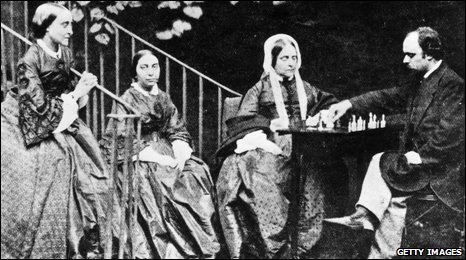
Os manos Rossetti, noutra foto de Lewis Carroll


Da esquerda para a direita:
Christina Rossetti (1830-1894), poeta e escritora; Maria Rossetti (1827-1876), freira e autora de um ensaio sobre Dante Allighieri; Frances Lavinia Polidori (1800-1886), a mãe; e Dante Gabriel Rossetti (1828-1882), pintor, fundador da Pre-Raphaelite Brotherhood e poeta.

domingo, 31 de julho de 2011

Christina Rossetti, outra vez


Estou correntemente a ler a antologia "Selected Poems" de Christina Rossetti, publicada em 1994 pela Wordsworth editions, que me faz lamentar que não exista uma edição de semelhante amplitude em Portugal. Palmas para a Relógio d'Água, no entanto, que já publicou uma antologia, ainda que bastante menor, com versões de Margarida Vale de Gato, já aqui comentada há uns meses.

Aqui deixo algumas curiosidades sobre aquela que será provavelmente o maior poeta Pré-Rafaelita: manuscritos, cartas, capas e páginas de edições antigas e recentes; e um retrato, pintado pelo irmão, o pintor e também poeta Dante Gabriel Rossetti.


sábado, 9 de julho de 2011

At Home


When I was dead, my spirit turned
To seek the much-frequented house:
I passed the door, and saw my friends
Feasting beneath green orange boughs;
From hand to hand they pushed the wine,
They sucked the pulp of plum and peach;
They sang, they jested, and they laughed,
For each was loved of each.

I listened to thier honest chat:
Said one: "To-morrow we shall be
Plod plod along the featureless sands,
And coasting miles and miles of sea."
Said one: "Before the turn of tide
We will achieve the eyrie-seat."
Said one: "To-morrow shall be like
To-day, but much more sweet."

"To-morrow," said they, strong with hope,
And dwelt upon the pleasant way:
"To-morrow," cried they, one and all,
While no one spoke of yesterday.
Their life stood full at blessed noon;
I, only I, had passed away:
"To-morrow and to-day," they cried;
I was of yesterday.

I shivered comfortless, but cast
No chill across the table-cloth;
I, all-forgotten, shivered, sad
To stay, and yet to part how loth:
I passed from the familiar room,
I who from love had passed away,
Like the remembrance of a guest
That tarrieth but a day.


Christina Rossetti

Goblin Market, The Prince's Progress and other poems

1879, ed. Macmillan

pintura de Edvard Munch

terça-feira, 17 de maio de 2011

Christina Rossetti: O Mercado dos Duendes e outros poemas (Versão de Margarida Vale de Gato)

É já de 2001 esta edição, organizada e prefaciada por Ana Rosa Nobre, de alguns poemas de Christina Rossetti, em versões de Margarida Vale de Gato.

Daquela que me parece ser a mais importante poeta Pré-Rafaelita existe, além deste livro, apenas uma outra selecção de poemas, na antologia "Os Pré-Rafaelitas: Antologia Poética", organizado por Helena Barbas e editado em 2005 pela Assírio e Alvim. É pena que assim seja, pois, como de resto acontece frequentemente com a publicação de poesia estrangeira no nosso país, isso gera uma lacuna considerável num dos períodos mais ricos da cultura britânica, neste caso.

Foi em 1862 que, depois de alguma publicação dispersa, Christina Rossetti lançou o seu primeiro livro: "Goblin Market and Other Poems", ilustrado com gravuras do irmão da poeta, o pintor e também poeta Dante Gabriel Rossetti, foi um sucesso, aliás, o primeiro grande sucesso da poesia Pré-Rafaelita, de tal maneira que Christina, como nos é explicado no prefácio, sempre temeu não ser capaz de igualar a qualidade do poema inicial, "Goblin Market".


O volume português, "O Mercado dos Duendes e outros poemas", leva o mesmo título do primeiro livro de Christina, mas não é uma tradução integral dele, preferindo fazer uma selecção de poemas colhidos da obra completa de Christina. A opção parece-me interessante dado que, na altura, era a primeira vez que esta autora era publicada em Portugal.

Abre então com o poema mais conhecido de Christina, "O Mercado dos Duendes". Ainda que, pessoalmente, me pareça que a intensidade da escrita de Christina Rossetti atinge o seu pico noutros poemas, mais íntimos, percebe-se o porquê do destaque dado a este poema. De facto, em muito, ele representa um culminar de várias características do Pré-Rafaelitas. Trata-se de um muito longo poema narrativo que nos conta a história de duas irmãs, Lizzie e Laura, que observam a passagem de um bando de duendes em direcção a um lugar onde venderão frutas que haviam colhido dos seus pomares. O poema inicia com os pregões dos duendes, em versos curtos, criando um ritmo viciante e muito musical. Laura sente-se tentada a ir ter com eles e comprar-lhes fruta ainda que Lizzie, mais cautelosa, a alerte para o perigo de comer a fruta vinda de criaturas "malditas"


"Não", disse Lizzie, "Não;

Suas ofertas não nos devem tentar,

Suas prendas do demo mal nos farão."

(p.33/35)


Como seria de esperar, certa noite, Laura foge de encontro aos gnomos e come dos seus frutos. Depois disso, lentamente começa a definhar. Lizzie, levada pela urgência de salvar a irmã, irá também de encontro aos duendes, para lhes comprar fruta, acabando por ser atacada por eles. Ainda assim, com o corpo sujo do sumo das frutas, consegue salvar a vida de Laura. Esta passagem é, de facto, assinalável, em vários aspectos: revela-nos, a um tempo, a dimensão poderosa do amor fraternal, mas também uma grande carga erótica (Ou homo-erótica, como se preferir.), assinalável se tivermos em conta que este poema foi escrito em 1859:


Gritou "Laura", assomando ao jardim,

"Sentiste falta de mim?

Anda, beija-me.

Não te apoquentes com minhas feridas,

Abraça-me, sorve das minhas seivas

Para ti espremidas dos frutos dos duendes,

Polpa de duende, orvalho de duende.

Come-me, bebe-me, ama-me.

Laura, faz de mim o que te aprouver,

Por teu amor ao vale eu desci

E c'os anões me tive de haver."

(p.61)


A modernidade deste poema está, não só na ousadia com que muitas vezes se manifesta, mas também nalguns detalhes técnicos, particularmente na métrica: apesar de seguir sempre esquemas rimáticos, estes vão-se alterando; e a métrica também se muda, como que para servir a energia do próprio poema: se inicialmente os pregões dos duendes eram escritos em versos curtos, à medida que o poema avança e se centra na relação entre as duas irmãs e o que se passa nas suas vidas, os versos vão-se tornando mais longos e mais densos. Ou seja, dentro da regularidade, Christina consegue tornar o esquema deste poema irregular.

A língua inglesa será uma das mais difíceis de traduzir para português. Logo porque as duas línguas pouco se equivalem e raramente sequer se aproximam, mas também pelas diferenças na contagem de sílabas e, no caso da poesia, da organização das estruturas, como Margarida Vale de Gato nos explica na sua nota final. Parece-me, no entanto, que "O Mercado dos Duendes" terá sido o poema mais difícil de traduzir precisamente por esta característica de tornar a regularidade irregular. Mesmo assim, sacrificando muitas vezes a exactidão das palavras de Christina, Margarida Vale de Gato consegue satisfatóriamente dar uma ideia do poema, tanto da sua mensagem como também da sua estrutura, ainda que, muitas vezes, a tradutora seja obrigada a torcer um pouco a estrutura original. O que é certo é que numa tradução há sempre alguma coisa que tem que ser sacrificada. Se compararmos a versão de Margarida Vale de Gato com a de Helena Barbas, veremos isso. Neste livro, a tradutora preferiu dar-nos uma noção aproximada da forma e da estrutura, e penso que a sua versão será suficiente para que essas duas questões sejam bem entendidas.

A nível temático, como dizia, este poema em muito vai de encontro aos interesses pré-rafaelitas. Para começar, a própria ideia do mercado dos duendes é muito medievalista e fantasiosa, e essas eram duas das linhas-mestras da ideologia deste grupo; e também a ideia dos frutos e da maneira como eles são descritos, cheia de colorido e de lirismo, vão muito de encontro a esta estética tão particular. E os conceitos mais gerais deste poema, que serão a tentação (Gerada pela beleza.) e a salvação (Resultante do amor.) são conceitos nada estranhos ao trabalho, quer plástico quer poético, da Pre-Raphaelite Brotherhood.

Meticulosa e inquieta, Christina, enquanto ia publicando outros livros, reeditou este seu primeiro cinco vezes, sendo que William Michael Rossetti o editou uma vez mais ainda, depois da morte da poeta, sua irmã.

Ainda sobre os poemas escolhidos do primeiro volume da autora, há que dizer que o rasgo de profunda imaginação que pauta em todos os aspectos o primeiro poema nunca é verdadeiramente perdido, ainda que os restantes poemas se afastem da matriz deste primeiro.

Ana Rosa Nobre seleccionou mais 17 poemas de "Goblin Market and Other Poems". Neles, encontramos temas mais intimistas e mais ligados à realidade emocional da autora, sendo que alguns deles se escrevem de uma forma mais reflexiva e outros mantém ainda o lado mais narrativo, como acontece com "The Convent Thresold/ No Limiar do Convento".

Seguindo estruturas mais definidas e mais clássicas, nomeadamente a do soneto, Christina fala-nos, acima de tudo, da solidão e da perda.

Estas duas noções são traçadas de várias matrizes. A primeira será a perda de uma paixão, de uma relação amorosa: nestes poemas, como "Remember/ Recorda" ou "After Death/Depois da Morte" ou "Echo/ Eco", intervém muitas vezes a morte, outro tema muito caro aos Pré-Rafaelitas. A morte é um assunto presente em quase todos os poemas deste livro. A tonalidade de agonia é essencial para entender a escrita de Christina Rossetti, pois ela parece colocar-nos continuamente perante um apodrecimento lento da vida, e, quando nos coloca em situações de morte, mantém sempre a capacidade de pensar e sentir. Nestes poemas, por assim dizer, Christina traça através de um corpo morto, o seu, uma espécie de espelho, pois é a partir dele que as situações se invertem: que o amor perdido regressa, e que a sua frieza se transforma em choro, como vemos, por exemplo, em "Depois da Morte":


Não tocou na mortalha nem no véu,

Nem p'ra me dar a mão a sua mão se ergueu;

Nem o coxim em que me estendia


Desmanchou; não me amou quando eu vivia;

Mas é bom saber que morta me deu

O seu calor, embora eu esteja fria.

(p.73)


É de notar como, nestes poemas, o olhar de Christina volta a mostrar-se-nos treinado para a atenção ao detalhe: estes poemas vivem muito de imagens, imagens criteriosamente escolhidas, pois são muitas vezes elas que ditam a energia do poema: paradas por vezes, quase mortas; outras vezes imagens de movimento, que nos dão conta de um estado de inquietude. Destas últimas, dou um exemplo, retirado de um dos poemas que leva como título "Song/ Canção":


Duas pombas pousadas num só galho,

Dois lírios gémeos a despontar,

Duas borboletas sobre uma flor:

Felizes os que os podem contemplar.

(p.77)


Christina Rossetti, que Virginia Woolf considerava "um génio" tem sido negligenciada, muito por ser mulher. A consciência desta questão não escapava à poeta. Apesar de ser considerada membro dos Pré-Rafaelitas, ela nunca o foi a tempo inteiro, pois as mulheres, à data, não tinham nem que remotamente, parte dos direitos e da liberdade que tinham os homens, pelo que o seu percurso foi sendo um bastante solitário, o de uma pessoa que se sentia "Morta Antes da Morte (Dead Before Death)"


Mudada e fria, fria e ressequida!

Lábios hirtos, olhar indiferente,

Contudo a mesma, pouco esclarecida;

Foi esta a promessa de antigamente.

(p.91)


Aqui encontramos um certo ressentimento à condição feminina, em que um estado de "pouco esclarecida", afecta o próprio corpo, o aspecto da autora, que, realmente, vemos de uma profunda tristeza nos vários retratos que dela fez Dante Gabriel Rossetti. A questão da mulher vai ser ainda essencial em dois momentos aqui antologiados. O primeiro é "Monna Innominata: Um Soneto de Sonetos", um conjunto retirado do livro "A Pageant and Other Poems", de 1881. No prefácio que escreve a este conjunto de 14 sonetos (Tantos como os versos de um soneto.), Christina fala-nos de Beatriz e Laura, imortalizadas por Dante Alighieri e Petrarca, "heroínas mundialmente famosas [que] foram precedidas por uma hoste de damas não nomeadas, "donne innominate" (...) Se uma dessas damas tivesse falado por si, talvez o retrato que nos deixasse fosse mais terno(...)" (p.145). É pois sobre o silenciamento que existe sobre as mulheres nas sociedades patricarcais e machistas que Christina se debruça nestes catorze sonetos, dos quais aqui temos quatro. A solidão e a imcompreensão são o fio de ariane que une estes textos. Não só as mulheres têm que viver na solidão de não poderem ter voz nem nome, como também têm que viver a condenação de nunca, verdadeiramente, serem entendidas em qualquer matéria. É isso que vemos no soneto 11:


Dirão de ti as gentes do porvir:

_Amou-a! _enquanto de mim, ufanas,

Hão-de dizer que te amei a fingir

Como fazem as mulheres levianas

(p.151)


e quando, no soneto 14, Christina diz


Perdida a beleza e a juventude_

Se é que algum dia o meu rosto foi belo_

Tudo perdido, foi-se a beatitude.

(p.153)


ela está, talvez discretamente, a lançar a mais dura crítica à sociedade patrircal, pois a mulher, quando perde a beleza e a juventude tem "Tudo perdido", ou seja, torna-se inútil e inexistente, pois o que na verdade lhe resta, os sentimentos e a inteligência, não são ouvidos por ninguém, anulando-a assim.

Esta distância entre o que a pessoa, neste caso a mulher, é, e o que dela é visto ou admitido é um assunto retomado em "In an Artist's Studio/ No Estúdio de um Artista", poema escrito em 1856 e só publicado postumamente


De dia e de noite o seu rosto venera,

E ela lhe devolve o olhar risonho

Brilhante como a lua e a claridade,


Sem que nunca a ensombre a saudade:

Não como é, mas como p'ra ele era;

Não como é, mas como surge em sonho

(p.191)


é possível que este poema se refira a Dante Gabriel Rossetti e Elizabeth Siddal, mas isso é irrelevante para o caso. O essencial deste poema é que o homem que venera o rosto da mulher não é capaz de o representar de acordo com aquilo que essa mulher é, mas apenas de acordo com aquilo que ele sonha (Pensa.) que ela seja. Mais uma vez, a verdadeira personalidade da mulher é anulada por uma falocracia de efeitos realmente assassinos para as mulheres.

Outro tema que é importante referir sobre esta antologia de Christina Rossetti é a do amor místico. Porque aqui, uma vez mais, se entende a modernidade desta poesia, que, recusando uma postura de pura adoração e admiração cristã, se situa muito mais na linha de uma Santa Teresa de Ávila, de uma Hadewijch de Antuérpia ou de um São João da Cruz. Longe de se transformar numa consolação para a vida, o amor espiritual escrito por Christina Rossetti ganha um lado físico, erótico e nem sempre de celebração, servindo muitas vezes como salvação. Assim vemos em "A Better Ressurrection/ Uma Melhor Ressurreição":


Minha vida é uma taça quebrada,

Taça que verte e não pode suster

De minh'alma uma só gota orvalhada

Ou doce néctar, neste frio de tolher;

Deitai ao fogo a coisa sem valor,

Fundi-a e refundi-a até enfim

Ser cálice para o meu Salvador:

Jesus, bebe de mim!

(p.109)


Ainda que a questão do amor místico seja de capital importância nalguma da poesia de Christina Rossetti, para este livro foram seleccionados poucos poemas desta temática.

Voltando às versões de Margarida Vale de Gato, penso que lhes cabe o mérito de nunca adulterarem a mensagem destes poemas, mas a opção de valorizar a forma, que não é errada, custa muitas vezes a perda de algumas subtilezas da poesia de Christina Rossetti, pelo que o ideal seria, como em todas as traduções, de resto, ser-se capaz de ler o original.

A poesia de Christina Rossetti mostra-se, acima de tudo, muito inventiva, particularmente no que toca à criação constante de imagens, trabalhadas a partir do real para uma dimensão mais lírica; que consegue sempre conciliar com estruturas regulares de rimas e de métricas, salvo nalgumas excepções. É de assinalar ainda a capacidade de Christina para o poema narrativo longo, onde, com excepção de "O Mercado dos Duendes", a poeta trabalha sobre situações do real quotidiano, como vemos acontecer um pouco em "The Convent Thresold/ No Limiar do Convento" ou, mais ainda, em "Songs in a Cornfield/ Desfolhada", onde quase se aproxima de uma poesia realista; um pouco por todo o livro "The Prince's Progress and Other Poems" de 1866, livro que parece, realmente, ser todo ele uma espécie de narrativa. É também uma poesia realmente dolorosa e atroz por vezes, que, acima de tudo, nos mostra um ser humano de rara capacidade de observação, que depois se transforma num lirismo cuidado e equilibrado.

segunda-feira, 16 de maio de 2011

Christina Rossetti pintada por Dante Gabriel Rossetti

pormenor de "Ecce Ancilla Domini! A anunciação"

Algumas notas sobre Christina Rossetti

Quando Christina começava a amá-lo e a delicada intimidade criativa diminuía a ansiedade sexual, Collinson retirou-se bruscamente. O seu catolicismo renascia, como que levantando do abismo em que o lançava a estética do grupo. De algum modo, ele roçara as paredes do inferno e recuava à pressa, apavorado, calcando aos pés a roupa enegrecida. Enviou a Christina um soneto em que dava como inconciliáveis o impulso amoroso e a devoção. Ela rasgou-o de imediato, prevendo o golpe que, de facto, não tardou. Muitos anos mais tarde, refê-lo, verso a verso. Ficara-lhe gravado na memória.

William conta como a saúda de irmã, já tão deteriorada, se agravou. Talvez o sentimento dominante fosse a humilhação, mais dolorosa do que um puro desgosto de abandono. Dir-se-á que os poemas recolheram parte da agonia. Eles aspiravam, como ventosas, os seus poros infectados. E, quando ela escrevia sobre a perda, sobre aquilo que morrera e aquilo que jazia no seu também já morto coração, a beleza da febre triunfava.


Hélia Correia

in "Adoecer"
2010, ed. Relógio d´Água

Christina Rossetti pintada por Dante Gabriel Rossetti


pormenor de "A Infância da Virgem Maria"

Canção

Quando eu morrer, meu querido,
Não me cantes canções tristes;
Nem rosas em minha campa
Plantes, nem sombrios ciprestes.
Sê tu a relva que cobre
E com orvalho me aquece;
E se quiseres recorda,
E se quiseres esquece.

Não hei-de sentir a sombra,
Não hei-de sentir a chuva;
Nem ouvir a cotovia
Cantando como viúva.
E, sonhando p'lo crepúsculo
Que nunca há-de findar,
Feliz possa eu lembrar
E feliz possa olvidar.


Christina Rossetti

Versão de Margarida Vale de Gato

in "O Mercado dos Duendes e outros poemas"

2001, ed. Relógio d' Água

Christina Rossetti desenhada por Dante Gabriel Rossetti


Song (1848)

When I am dead, my dearest,
..........Sing no sad songs for me;
Plant thou no roses at my head,
..........Nor shady cypress tree:
Be the green grass above me
.........With showers and dewdrops wet;
And if thou wilt, remember,
..........And if thou wilt, forget.

I shall not see the shadows,
..........I shall not feel the rain;
I shall not hear the nightingale
..........Sing on, as if in pain:
And dreaming through the twilight
...........That doth not rise nor set,
Haply I may remember,
............And haply may forget.


Christina Rossetti


Goblin Market and other poems


1862